
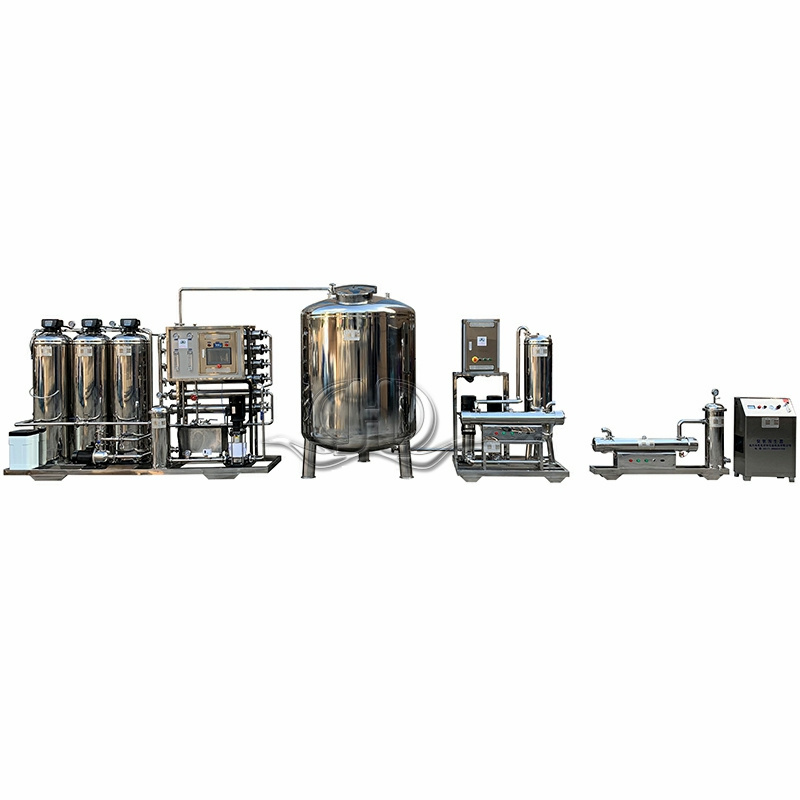
Sand Filter, Carbon Filter, Fully Automatic First Stage Reverse Osmosis Belt Precision Filtration Water Treatment Equipment
Product description
1、 Core equipment composition and functions
1. Sand Filter
Function: Through the physical interception effect of quartz sand filter material, large particle impurities such as suspended solids, sediment, rust, colloids, etc. in raw water are removed, reducing turbidity (usually from 20NTU to ≤ 5NTU).
Structure and operation:
The cylindrical tank is filled with quartz sand (particle size 0.5-1.2mm), with a filter layer thickness of 1000-1500mm and a filtration flow rate of 5-10m/h.
Fully automatic backwashing: PLC controlled pressure differential triggering (>0.05MPa) or timed triggering, backwashing intensity 15-20L/(m ² · s), lasting for 5-10 minutes, without manual intervention.
2. Carbon Filter
Function: Utilizing the adsorption properties of coconut shell activated carbon, remove residual chlorine (removal rate>99%), organic matter (such as TOC ≤ 3mg/L), pigments, and odors from water, and protect subsequent reverse osmosis membranes.
Key parameters:
Activated carbon has a specific surface area of ≥ 1000m ²/g, a contact time of ≥ 15 minutes, and residual chlorine in the effluent is ≤ 0.1mg/L.
Automatic backwashing is linked with the sand filter to avoid system flow fluctuations caused by simultaneous operation.
3. Precision Filtration
Function: Also known as a security filter, it is installed in front of the RO membrane with a filtration accuracy of 5 μ m. It intercepts small particles and colloids (such as silicon particles and iron manganese oxides) remaining after sand filtration/carbon filtration, preventing scratches or blockages on the membrane surface.
Filter type: PP melt blown filter, with strong dirt absorption capacity, replacement cycle of 1-3 months (when the pressure difference is greater than 0.1MPa).
4. Fully automatic First Stage Reverse Osmosis (RO)
Desalination principle: Driven by a high-pressure pump (0.8-1.5MPa), the raw water passes through a roll type composite membrane (such as Dow BW30, Heiden ESPA) to intercept dissolved salts (desalination rate of 95% -98%), bacteria, viruses, etc. The conductivity of the produced water is ≤ 50 μ S/cm (when the TDS of the raw water is < 2000mg/L).
Automated control:
Real time monitoring of pressure, flow rate, and conductivity, automatically starting and stopping based on the pure water tank level (low level start, high level stop).
Automatically rinse the surface of the film before/after startup (rinsing time 1-3 minutes) to prevent the deposition of pollutants.
2、 System Process and Water Quality Control
1. Complete processing flow
plaintext
Raw water → sand filter (to remove large particles) → carbon filter (to remove residual chlorine/organic matter) → precision filter (5 μ m) → primary reverse osmosis (desalination) → purified water (to meet discharge standards or reuse)
2. Key indicators of water quality
Turbidity (NTU), residual chlorine (mg/L), conductivity (μ S/cm), TDS (mg/L), total bacterial count (CFU/mL) during the processing stage
Raw water ≤ 20 ≤ 1.0 ≤ 2000 ≤ 1200 ≤ 1000
Sand filtration+carbon filtration ≤ 5 ≤ 0.1 ≤ 1800 ≤ 1080 ≤ 100
RO water production ≤ 1 ≤ 0.05 ≤ 50 ≤ 30 ≤ 10
Standard limit (industrial water) ≤ 5 ≤ 0.1 ≤ 1000 ≤ 600 ≤ 100
3、 Application scenarios
1. Industrial production field
Electronics and Semiconductors: Chip cleaning water (conductivity ≤ 10 μ S/cm), compatible with EDI to produce ultrapure water.
Food and beverage: Process water (if used for juice preparation or beer brewing) that meets the GB 5749 standard to ensure taste and safety.
Chemical and Energy: Boiler makeup water (hardness ≤ 0.03mmol/L), circulating cooling water (conductivity ≤ 300 μ S/cm), to reduce equipment losses.
2. Civil and commercial fields
Residential direct drinking water system: The conductivity of the produced water is ≤ 50 μ S/cm, and it is equipped with a UV sterilizer to meet the demand for direct drinking.
Rural well water purification: treating high turbidity and high residual chlorine well water, removing sediment, odors, and some salt.
3. Special Scenarios
Laboratory water: As a basic equipment for pure water (which can be connected to ultrapure water machines in the future), it meets the needs of routine experiments.
Pre treatment of seawater desalination: combined with multi-stage RO to reduce the pre-treatment load of high salt seawater.
4、 Technical features and advantages
1. Fully automatic operation, reducing labor costs
The PLC control system links various devices to automatically execute filtering, backwashing, water production, and shutdown processes, and supports remote monitoring (such as Modbus protocol access).
2. Multi level filtration collaboration ensures stable and reliable water quality
Physical filtration (sand filtration)+chemical adsorption (carbon filtration)+precision interception (security filtration)+deep desalination (RO), layer by layer purification ensures water quality meets standards.
3. Energy saving design to reduce operating costs
High voltage pump frequency conversion control, with an average energy consumption of 1-2 kWh/m ³, saving 15% -25% energy compared to traditional systems;
The reverse osmosis recovery rate is 60% -80%, reducing the discharge of concentrated water.
4. Flexible adaptation and strong scalability
Softening devices (for treating high hardness water), dosing devices (for flocculation/scale inhibition), or secondary RO (for treating high salt water quality) can be added according to the quality of the raw water.
5、 Maintenance and troubleshooting
1. Daily maintenance checklist
Technical points for equipment maintenance content cycle
Check the loss of filter material in the sand filter, supplement quartz sand every six months if the loss rate of filter material is greater than 10%, and investigate if the turbidity after backwashing is greater than 2NTU
The carbon filter detects residual chlorine in the effluent and replaces the activated carbon when the residual chlorine exceeds 0.1mg/L annually. The adsorption capacity is restored to ≥ 90%
Replace the precision filter with PP melt blown filter element after 1-3 months when the pressure difference is greater than 0.1MPa, and pay attention to aseptic operation
RO membrane element chemical cleaning (acidic/alkaline) every 6-12 months when the pressure difference is greater than 0.3MPa or the water production decreases by 20%
Check the bearing oil level of the high-pressure pump, test the head, and replenish it every quarter when the oil level is insufficient. If the head drops by more than 10%, maintenance is required
2. Common faults and solutions
Possible causes and solutions for the fault phenomenon
RO water production decreases due to membrane fouling/low inlet water temperature, chemical cleaning of membrane/raising water temperature to above 15 ℃
The conductivity of the produced water increases, and the membrane element is damaged/the opening of the concentrated water valve is insufficient. Replace the membrane/adjust the concentrated water valve to a recovery rate of 70%
Carbon filter effluent odor activated carbon saturation/sudden increase in organic matter in raw water Replace activated carbon/Strengthen front-end pretreatment
Poor backwashing effect of sand filter, filter material compaction/insufficient backwashing pressure, backwashing of filter material/checking the performance of backwashing pump
6、 Selection and configuration suggestions
1. Select based on water production rate
Small system: 1-5m ³/h, suitable for laboratories and small stores, covering an area of 3-6 square meters, with a power of 3-7.5kW.
Medium sized system: 10-20m ³/h, suitable for hotels and food processing plants, requiring a 20-50m ³ water tank and a power of 10-15kW.
Large scale system:>50m ³/h, suitable for industrial parks, using multiple sets of membranes in parallel, power>30kW, requiring a dedicated machine room.
2. Targeted configuration of raw water quality
High hardness water (>200mg/L): Add softening device (ion exchange resin) or scale inhibitor (such as CP118).
High turbidity water (>10NTU): pre flocculation dosing (PAC/PAM)+sedimentation tank to reduce sand filtration load.
High residual chlorine water (>1mg/L): Add reducing agent (such as sodium bisulfite) before the carbon filter.
3. Environmental protection and safety configuration
Concentrated water treatment: Concentrated water with TDS<1000mg/L can be reused for greening, while TDS>3000mg/L requires evaporation crystallization treatment.
Material safety: Components that come into contact with drinking water are made of food grade stainless steel (304/316L) or sanitary grade PE, in compliance with GB 17219 standard.
summarize
This water treatment equipment achieves efficient removal of physical impurities and dissolved salts through a combination of “sand filtration+carbon filtration+precision filtration+first stage RO”. It is suitable for industrial production, civil water purification, and mild wastewater treatment and reuse. Its fully automatic operation, energy-saving and low consumption, and flexible adaptability make it an ideal solution to solve problems such as turbid water quality, high salt content, and odor. Users can adjust the configuration according to specific needs to ensure stable operation of the system under different water quality conditions, achieving a balance between efficient purification and cost optimization.
-

Sand Filter, Carbon Filter, Fully Automatic Rev...
-

Fully automatic reverse osmosis pure water mach...
-

Quartz Sand Filter Active Carbon Filter Precisi...
-

Reverse Osmosis Precision Filtration, Ozone Ste...
-
Reverse Osmosis water treatment filter for dire...
-

Reverse Osmosis Belt Softened Sand Filter Carbo...